


Last year, we wrote about Scout, Traba’s AI interviewer.
To recap: light industrial staffing — the lifeblood of the global supply chain — is a brutal operational funnel. Filling a single shift means moving a real person through a gauntlet of physical-world gates (interviews, drug screens, background checks, certifications) and then matching them to the right job at the volume and speed that massive industrial operations demand. Keeping that funnel flowing and effective year round is one of the biggest challenges in the entire industry.
To wit: the conversion rate from interested applicants to filled positions can be as low as 1-2%.
Yet, workers that match the requisite qualifications absolutely exist plentifully. As such, to fulfill our mission of making the global supply chain operate at peak efficiency, we must meet them where they are. To do so at the scale and speed necessary for enterprise industrial operations, automated AI at scale is the only viable solution.
Scout manages the vetting aspect of this funnel — it communicates with workers over voice and text, asks precise questions about role qualifications and shift logistics, and decides whether they’re qualified for a shift. Over half a million worker interviews in, it’s been a resounding success.
But vetting is just one part of the human funnel. Much more goes into ensuring the success between great workers and great businesses.
In order to create a healthy pipeline, you need a strong acquisition mechanism (reaching communities to build reliable labor pools), intelligent marketplace matching, and flawless operational execution to move every worker through physical-world gates (drug screens, background checks, certifications).
The real world is a messy place. We refer to the application of AI to resolve real world problems as “Physical AI”.
What is “Physical AI”?
Physical AI represents the domain of AI systems built to act directly in the real world rather than live entirely in the digital space. In a present universe in which foundational labs seem capable of absorbing every pure-digital task conceivable, “the moat of the real world” becomes the subject of immense scrutiny. The real world comes with a mountain of overhead: hardware, latency, messy human behavior, and human consequences when AI misbehaves. These are fundamentally different missions that frontier labs are unlikely to take on.
But physical AI is about more than machines. Presently, our global supply chain’s efficiency is determined by the productivity and agency of the humans who show up day in and day out. In 2026, physical AI is about perfecting the autonomous processes that vet, qualify, train, retain, resource, pay, and support human operators.
A suboptimal vetting call costs a strong worker a shift, or sends an incompatible worker to a business. A misfired worker SMS or call at 6am loses trust (and sleep). A bad assessment of a worker’s pay rate preferences inevitably escalates into manual operator support down the line. There is no SWE-bench to optimize against here, as correctness is subjective.
Fortunately, because we control the entire productivity loop (worker engagement → onboarding / employment → vetting / qualification → requirements → selection → performance / execution) we still can construct sensible objective functions by evaluating empirical results from our worker’s performances.
Our goal is a healthy marketplace built on consistent workers — people who keep showing up and do good work, shift after shift, for months.
As a top line measurement, a worker who gets through their first five shifts in their first month is nearly four times as likely to still be picking up shifts six months later as one who stops after a single shift. So we optimize the whole funnel toward getting workers past that early threshold.
The Industrial Staffing Funnel
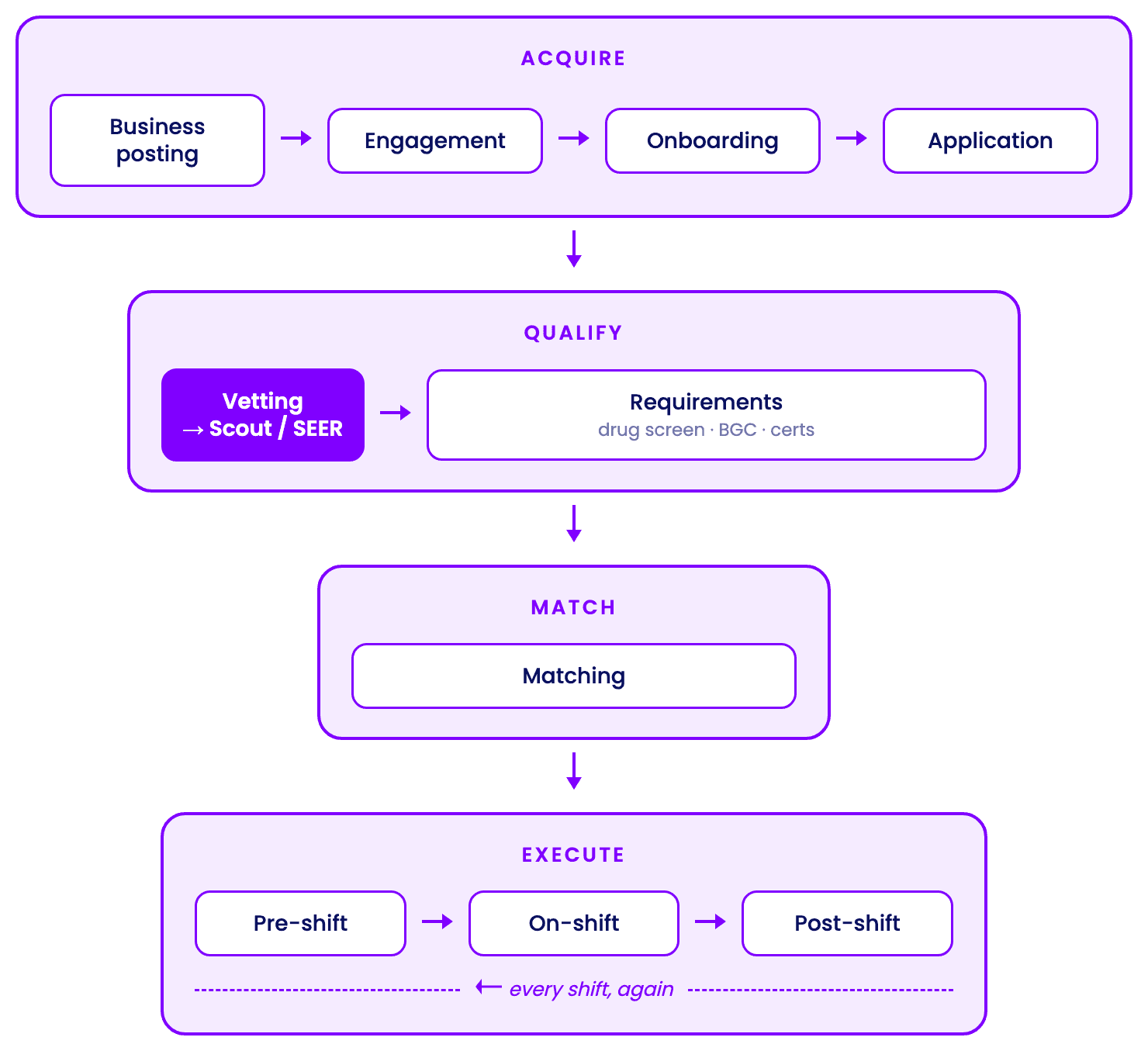
So what is the funnel that defines a worker lifecycle? Roughly it can be approximated to the following series of steps:
Business Posting — A business posts the exact requirements for an industrial job opportunity
Engagement — A worker is engaged for said job opportunity, through ads, referrals, in person engagement, or otherwise.
Onboarding — A worker signs up via the Traba app and provides key information to determine if they are eligible for any number of job opportunities
Application — A worker formally applies for the opportunity via the Traba app
Vetting — We evaluate the worker for the qualifications relative to the specific job opportunity
Requirements — Workers need to fulfill requirements (drug screens, background checks, orientations and tours, live interviews, etc.)
Matching — We decide on the final set of workers to bring on shift
Pre Shift — Confirming with the worker all details to be successful on the job
On Shift — Guiding and tracking the worker en route to shift, handling clock in / clock out, and performance management
Post Shift — Performance evaluation, post shift feedback, payments and invoicing
To optimize for our end goal, every step of the funnel will need to be driven and executed by agents.
In this series of blogposts, we’ll be expanding on key agent infrastructure and development that has contributed most tangibly to our success in building the fastest growing industrial staffing operation on the planet.
We’ll be looking at agent development from a problem statement perspective. e.g.:
Business Posting: How do we build a self-ingesting knowledge base that can keep up with shifting customer demands?
Onboarding: How do we convert pieces of data about workers into precise qualifications to search from?
Vetting: How do we construct a pliable eval that lets us iterate on vetting interviews safely?
Requirements: How do we conversationally manage an entire worker lifecycle such that we can push opportunities, resolve worker issues, dig into worker performance, etc?
Matching: How do we optimize when and how workers receive communications so they receive valuable information without being overwhelmed?
For each interesting problem that we’ve had to face, we’ll expand on a chapter in this blog series. We’re starting with the one that sits underneath all the others — the eval problem.
How do you trust an AI to make decisions about a real person’s livelihood, and to continue to keep this trust as the roles, the questions, and the models all change beneath you?
See you in Beyond Scout Chapter 1: SEER.